

General Wellness
Why Thyroid Issues Are Rising - And How Ayurveda & Yoga Support Real-Life Wellness
Thyroid issues are rising as stress, poor sleep, and fast‑paced living disrupt hormone balance. This guide explains how Ayurveda and yoga support thyroid health through four simple pillars-understanding your body’s rhythm, mindful movement, balanced nutrition, and daily lifestyle
Thyroid issues are popping up everywhere these days — in men, in women, and at every age.
People are tired all the time, dealing with brain fog, stubborn weight changes, anxiety, sleep problems, and low energy. It’s starting to feel “normal,” even though it shouldn’t be.
Modern life runs faster than our bodies can keep up — stress, irregular routines, processed food, and environmental overload push the thyroid into overwork.
The important thing is this: Medical care is essential, and Ayurveda and yoga can support the daily habits that shape digestion, stress, sleep, metabolism, and overall balance.
Why Thyroid Issues Are Rising
Thyroid problems aren’t increasing because people suddenly became less healthy — they’re increasing because modern life puts steady pressure on the systems that regulate hormones, metabolism, and energy. Here’s what’s driving the rise:
Chronic stress keeps the nervous system in “alert mode,” which interferes with thyroid hormone production and conversion.
Screen‑heavy days overstimulate the brain and disrupt natural hormonal rhythms.
Irregular sleep throws off the body’s timing signals, affecting metabolism and energy regulation.
Nutrient gaps (like iodine, selenium, zinc) make it harder for the thyroid to function smoothly.
Environmental chemicals from plastics, pollution, and household products add extra strain on the endocrine system.
Fast‑paced living keeps the body in a constant state of “go,” leaving little room for recovery or calm.
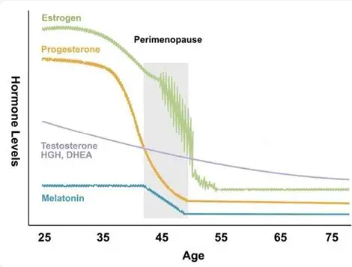
Hormonal shifts across different ages create windows where the thyroid becomes more vulnerable.
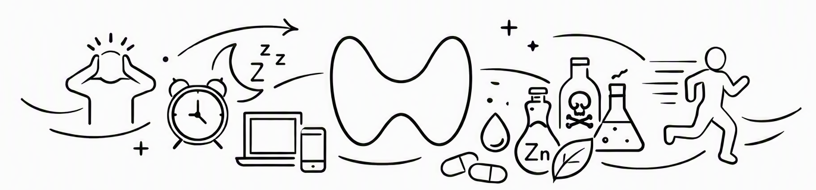
Over time, these pressures stack up, and the thyroid carries more load than it was built for. That strain shows up as the fatigue, mood shifts, and metabolic changes so many people face today.
What Thyroid Issues Actually Are
Thyroid issues happen when the thyroid gland doesn’t make or use hormones the way it should. These hormones control energy, metabolism, mood, and how fast or slow the body runs. When the thyroid is out of balance, the whole system feels off — not because the thyroid works alone, but because it’s connected to digestion, stress, sleep, and the nervous system. Thyroid issues can show up as the body running too slow, too fast, or constantly fluctuating between the two.
The thyroid is your body’s “speed controller” — it sets the pace for energy, metabolism, and mood.
Thyroid hormones act like messengers — when they’re too low or too high, the whole system feels off.
Imbalance affects multiple systems — digestion, sleep, stress response, temperature regulation, and mental clarity.
Symptoms vary widely — from fatigue and weight changes to anxiety and heart rate shifts.
Thyroid issues aren’t one-size-fits-all — some people slow down (hypothyroid), some speed up (hyperthyroid), and some fluctuate.
It’s not just the thyroid itself — it’s how the thyroid interacts with the gut, brain, hormones, and nervous system.
Early signs are often subtle — which is why many people miss them until they build up over time.
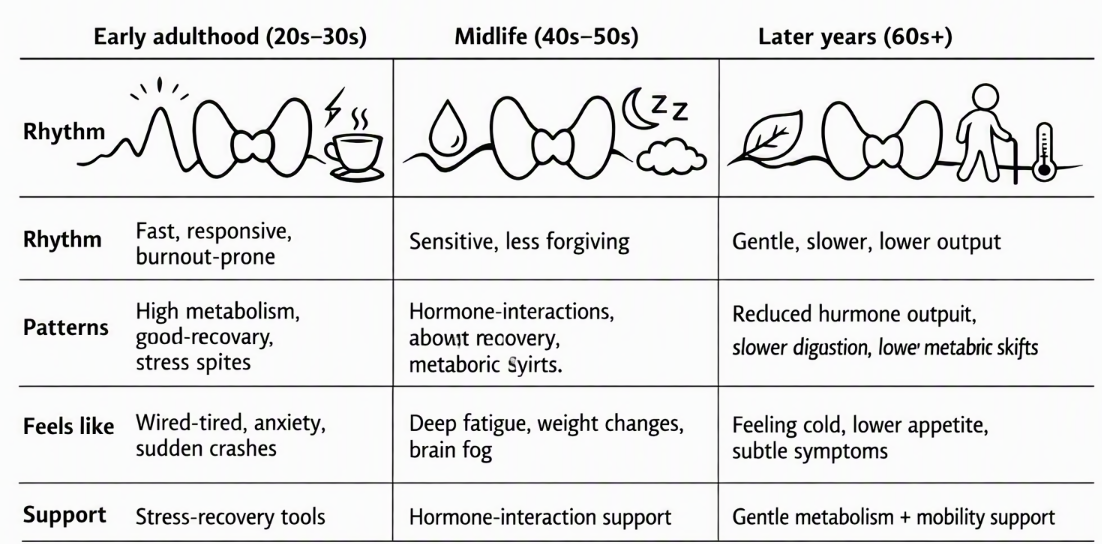
Age‑Related Thyroid Patterns
The thyroid doesn’t stay the same throughout life. Its rhythm shifts with age — not because it “breaks,” but because metabolism, hormones, stress tolerance, and recovery all change over time. Understanding these patterns helps people recognize what’s normal aging versus what’s a true thyroid imbalance.
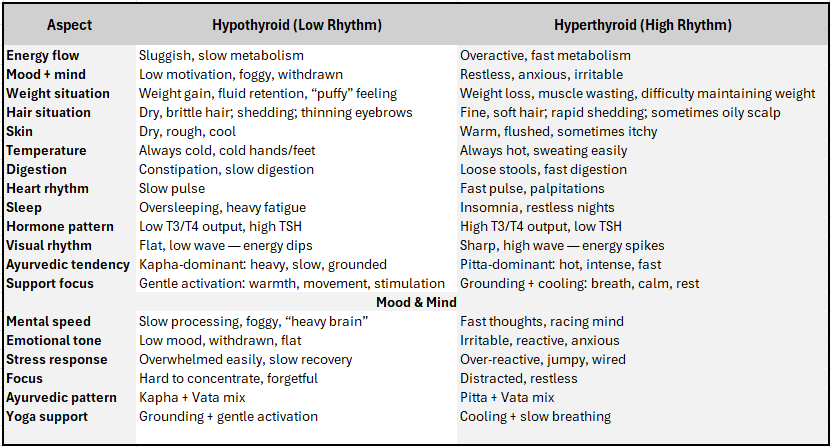
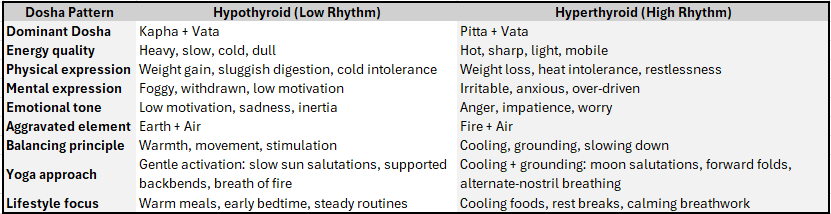
Hypothyroid vs Hyperthyroid
When thyroid rhythm slows down or speeds up, the body’s entire energy system shifts. Think of it like a thermostat that’s either stuck on “low heat” or “overdrive.”
THYROID 4‑PILLAR LAYOUT
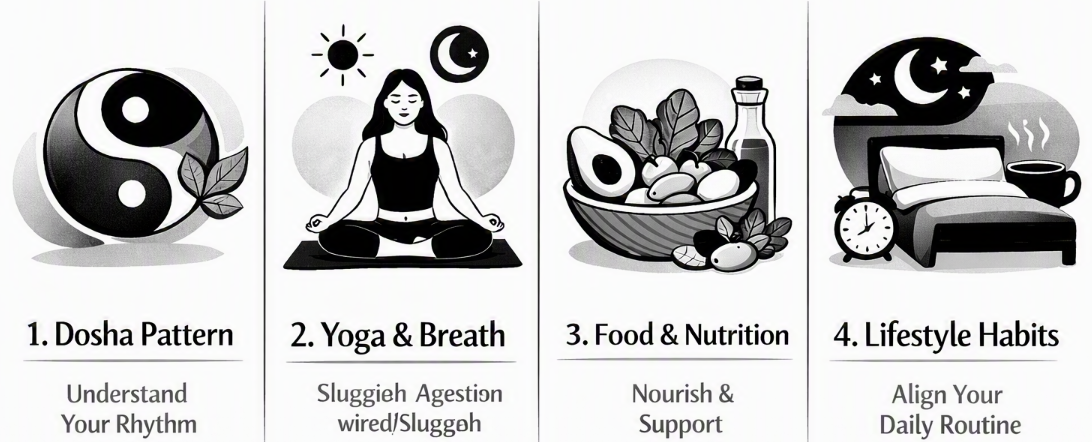
Each pillar answers a different question:
1️⃣ What’s happening? → Dosha Pattern
2️⃣ How to move? → Yoga Support
3️⃣ How to nourish? → Food Support
4️⃣ How to live daily rhythm? → Lifestyle Support
Pillar 1 — Dosha Pattern (The State)
Lets connect the Thyroid rhythm (low vs high) to the Ayurvedic doshas — showing how each imbalance expresses through body, mind, and energy.
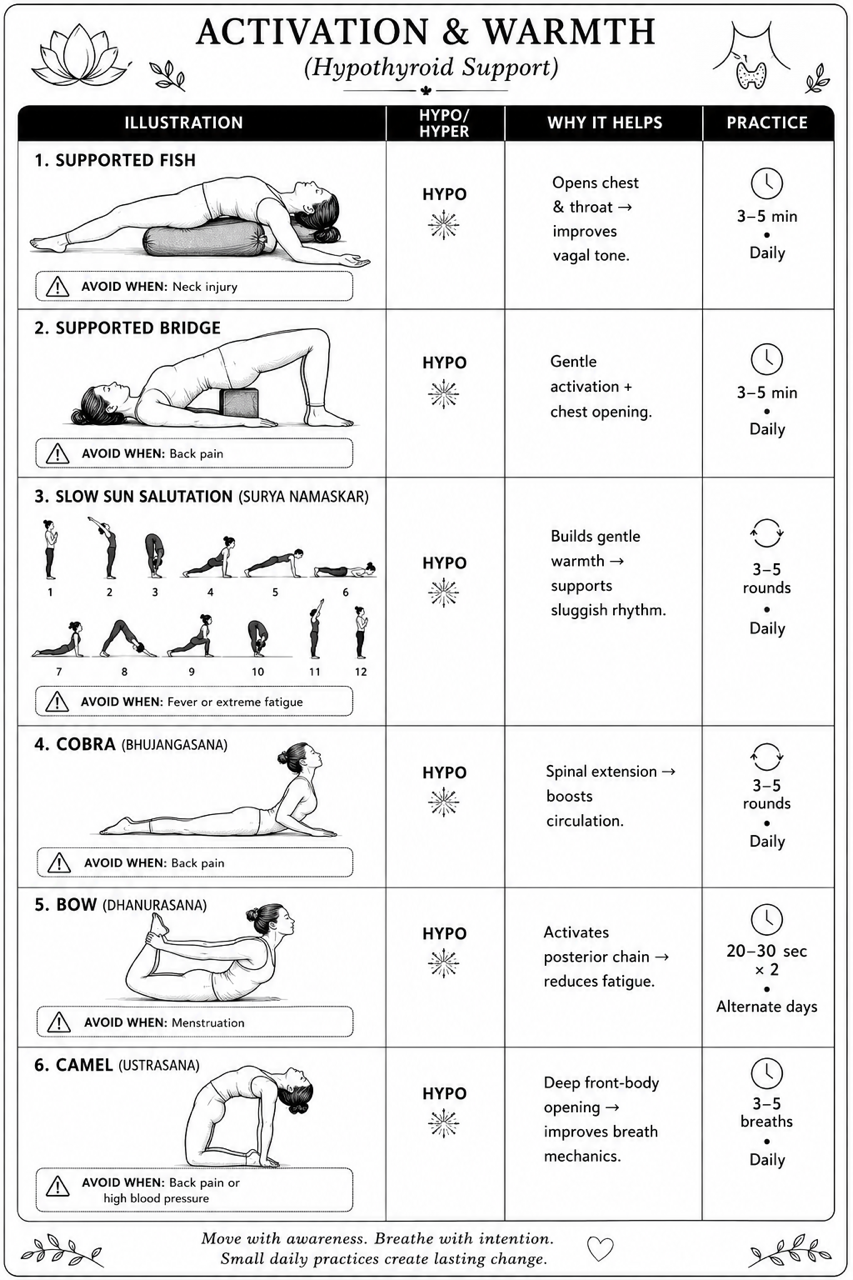
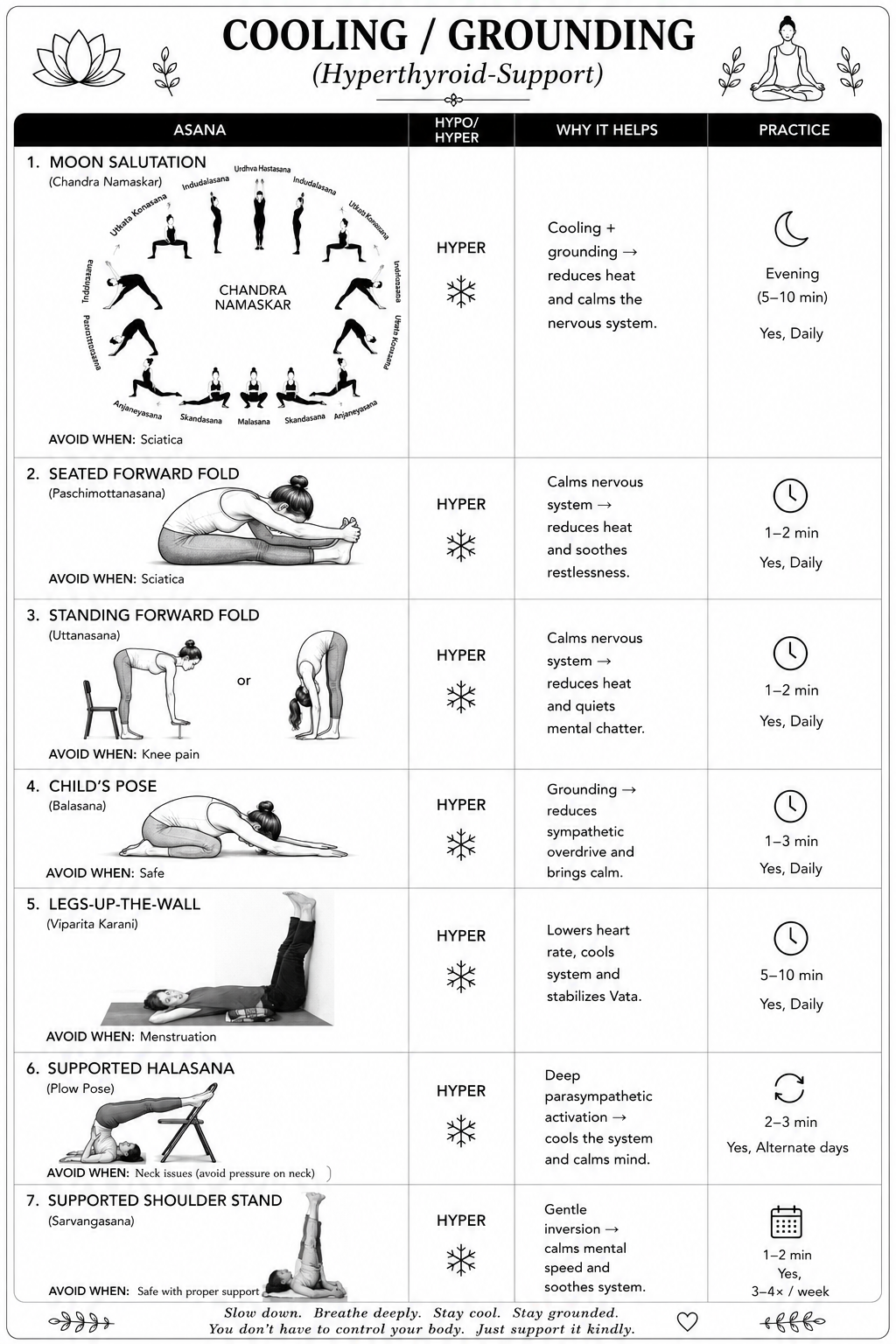
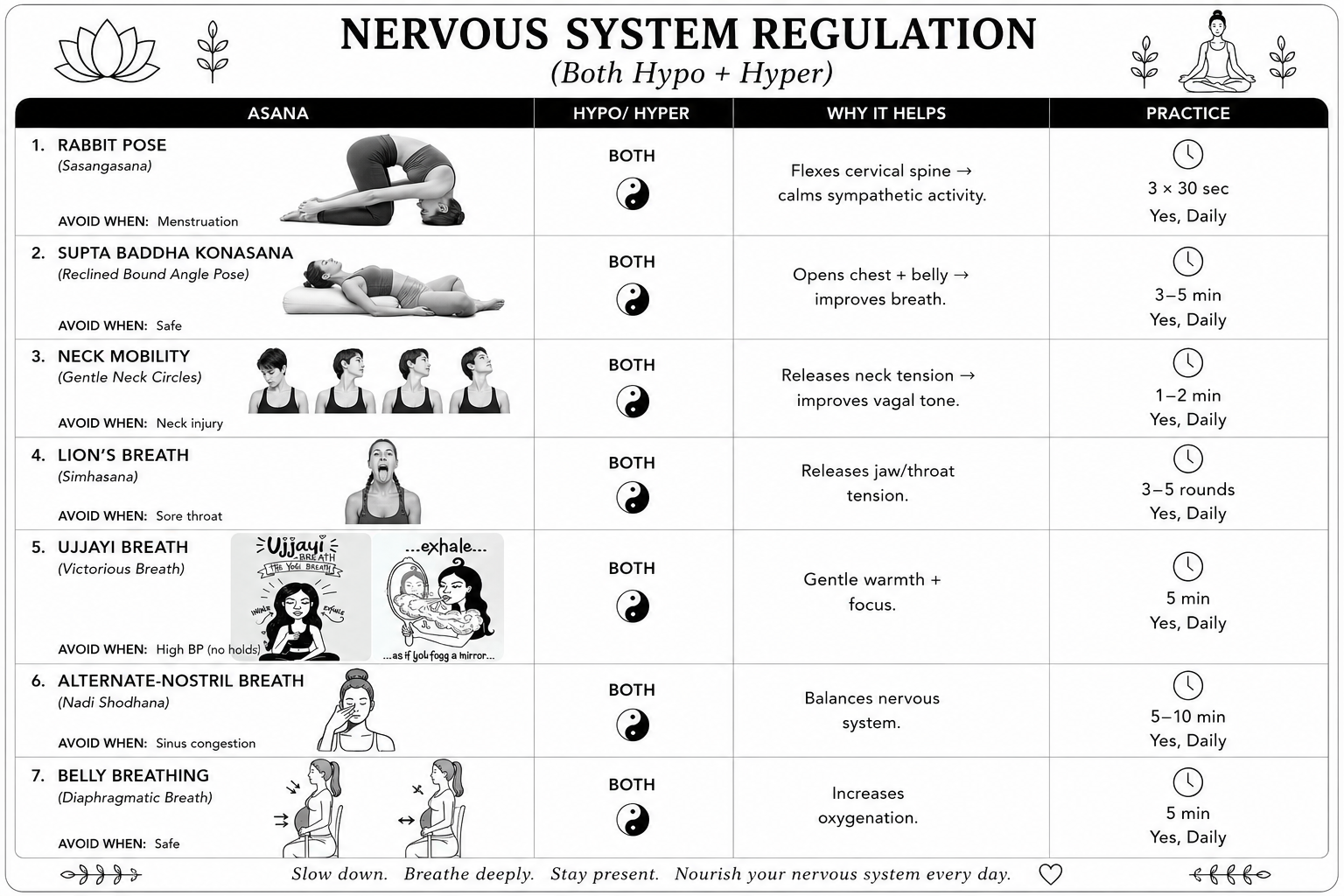
Pillar 2 — Yoga Support for Thyroid Rhythm
Yoga don’t “fix” thyroid hormones —Poses don’t “massage the thyroid” or “increase thyroid hormone.” They help because they change nervous system tone, circulation, breath mechanics, and stress load — all of which directly influence thyroid rhythm.
✔️ They help because they change nervous system state, not thyroid pressure.
Inversions → calm sympathetic overdrive
Chest openers → improve vagal tone
Forward folds → reduce internal heat
Rhythmic movement → stabilizes stress hormones
✔️ They help because they improve breath mechanics
Better breathing → better oxygenation → better energy production → better metabolic rhythm.
✔️ They help because they regulate circulation + lymph flow
This supports inflammation reduction and hormonal balance indirectly.
✔️ They help because they stabilize daily rhythm
Which is the real foundation of thyroid symptom management.
Pillar 3— Food Support (Nutrition + Digestion)
Explores how the warmth, texture, and timing of meals shape thyroid rhythm — guiding digestion, circulation, and nervous‑system balance rather than chasing hormone stimulation


Eating to Comfortable Fullness
Eating for thyroid rhythm isn’t about portion control — it’s about stopping at comfortable fullness. Warm, balanced meals naturally guide appetite and digestion so you don’t have to count or measure.
What comfortable fullness feels like:
Satisfied, not stuffed
No heaviness
Steady energy for a few hours
How to support it:
Warm meals help hypo patterns feel full
Smaller, frequent meals steady hyper patterns
Carbs + protein + healthy fats keep blood sugar stable
Slower eating helps digestion stay in rhythm
Comfortable fullness keeps digestion steady, prevents cortisol spikes, and supports thyroid rhythm — the simplest way to eat in sync with your system.
Blood Sugar Rhythm
Thyroid rhythm depends on steady blood sugar, not spikes or crashes. Warm meals, moderate carbs, and regular timing keep insulin stable — which supports T3 conversion and nervous‑system balance.
How to keep blood sugar steady:
Eat at consistent times
Pair carbs + protein + healthy fats
Choose warm, balanced meals for hypo patterns
Use smaller, frequent meals for hyper patterns
Stable blood sugar = stable thyroid rhythm. It keeps energy smooth, digestion steady, and cortisol low — the foundation for feeling regulated.
Micronutrient Essentials
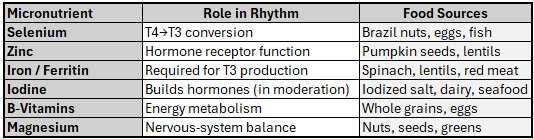
Iodized salt isn’t mandatory, and Himalayan salt isn’t superior — the goal is balanced iodine intake. If you eat dairy, eggs, or seafood, you already get iodine and can use any salt you like. If you avoid those foods, a little iodized salt helps prevent deficiency.
For Hashimoto’s or hyperthyroid patterns, non‑iodized salts may be gentler because they avoid iodine excess.
Daily Practice - Your Thyroid Rhythm Routine
Begin the day with a warm meal to set digestion and energy rhythm
Build each meal with balanced components: veggies, protein, carbs, healthy fats
Keep consistent meal timing to support blood‑sugar stability
Adjust temperature: warm/cooked for hypo, cooling/hydrating for hyper
Sip warm liquids through the day to steady digestion and circulation
Steady habits create steady rhythm — the simplest way to support thyroid balance daily.
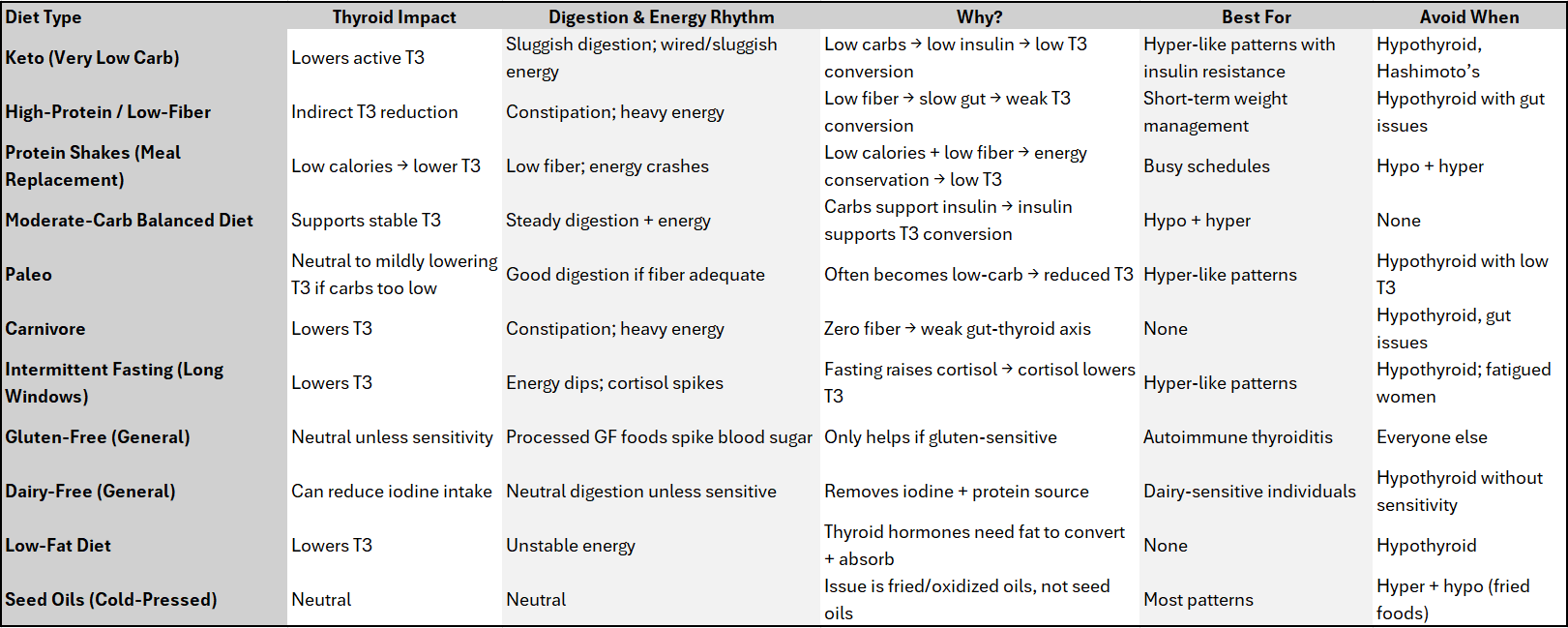
Drowning In Modern Diet myths
Modern diets often confuse “control” with “balance.”
They promise hormone optimization but actually disrupt rhythm by starving the body of warmth, fiber, and steady energy.
🔹 Common patterns:
Low‑carb → low insulin → low T3 conversion
Low‑fiber → slow gut → weak thyroid‑gut axis
Low‑fat → poor hormone absorption
Long fasting → high cortisol → suppressed T3
🔹 What works:
Moderate carbs + fiber + healthy fats
Warm, regular meals
Digestive rhythm over calorie restriction
The Thyroid Plate (Daily Guide)
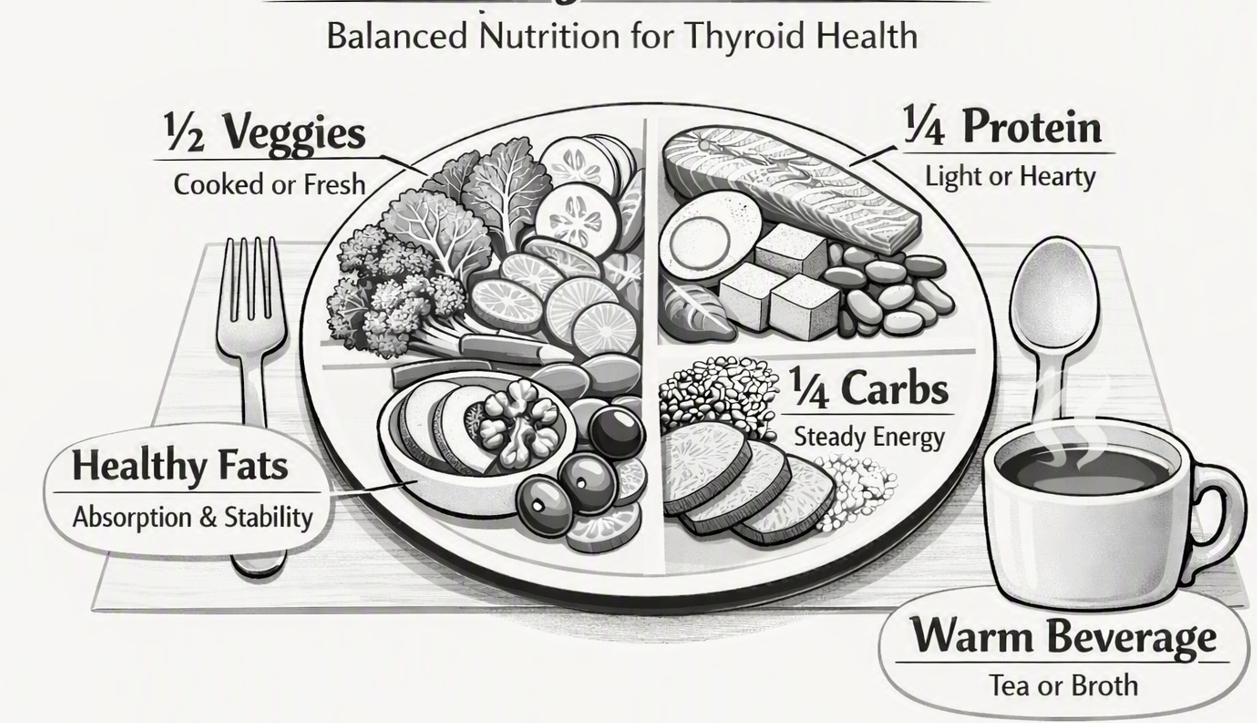
Your plate should include:
½ veggies (warm/cooked for hypo, cooling/hydrating for hyper)
¼ protein (light vs grounding)
¼ carbs (steady energy)
Healthy fats (absorption + hormone stability)
Warm beverage (digestion + circulation)
Food is rhythm medicine — not restriction. Warmth, texture, timing, and balanced plates shape how your thyroid, gut, and nervous system communicate.
Comfortable fullness, steady blood sugar, and micronutrient support keep T3 conversion stable without restriction or extremes.
Daily habits matter more than diets: warm meals, balanced components, consistent timing, and gentle hydration.
When digestion stays steady, thyroid rhythm follows — giving you smoother energy, calmer mood, and a body that feels regulated.
Pillar 4 — Lifestyle Support Daily Rhythm
How you structure your day shapes thyroid rhythm more than intensity, motivation, or willpower.
Lifestyle Support is about steady cues that keep hormones, digestion, and the nervous system in sync. Small, predictable habits create the environment your thyroid needs to stay regulated.
Core Daily Rhythm Habits
Morning Light — natural light within the first hour anchors cortisol and energy rhythm
Hydration Rhythm — warm liquids through the day support circulation and digestion
Consistent Sleep Window — similar bedtime/wake time stabilizes hormone release
Balanced Work Pace — alternate focus + breaks to prevent adrenal strain
Calm Transitions — shift between tasks slowly to avoid nervous‑system spikes
Digital Boundaries — reduce late‑night screens to protect melatonin rhythm
Gentle Evening Wind‑Down — dim lights, slower pace, quiet activities
Hypothyroid- If You Tend to Run Slower
Add warmth and activation: morning light, warm drinks, predictable routines
Keep transitions simple to reduce overwhelm
Use short breaks to maintain clarity and steady energy
Hyperthyroid-If You Tend to Run Fast
Add cooling and grounding: quiet evenings, slower pacing, calming breathwork
Avoid overstimulation: multitasking, rushing, intense environments
Use gentle pauses to settle the system throughout the day
Daily Rhythm Checklist
Morning: light + hydration + calm start
Midday: pause + breathe + steady meal
Evening: slow down + disconnect + dim lights
Daily rhythm is the quiet force that keeps your system steady. Light, pacing, transitions, and evening wind‑down shape how your hormones fire and how your energy feels. When your day has gentle structure — predictable mornings, balanced work flow, warm hydration, calmer evenings — your thyroid doesn’t have to fight for stability.
If you run slower, warmth and simple routines help you build momentum.
If you run fast, cooling and grounding cues help you settle.
Small habits repeated consistently create the environment your body trusts.
Before we close, let’s answer the question almost everyone asks about thyroid health: What about medication?
Thyroid Medication & Long‑Term Support
Many people taking thyroid medication wonder if it’s lifelong. For many, it is long‑term because the thyroid struggles to make enough hormone on its own.
But daily habits still matter — steady routines, warm meals, stress reduction, and mindful movement can help the body feel more balanced and support energy.
Some people see their dose adjusted over time, but any changes should always be guided by regular blood tests and a healthcare professional.
Lifestyle doesn’t replace medication, but it can make your thyroid’s job easier and help you feel better day to day.
When medication can sometimes be reduced
There are situations where the thyroid may function better over time, or where the body uses thyroid hormone more efficiently. In these cases, doctors sometimes reduce the dose:
Postpartum thyroid shifts
Subclinical hypothyroidism
Stress‑related thyroid suppression
Certain Hashimoto’s phases (early or fluctuating)
People who were over‑medicated initially
Lifestyle changes — steady routines, stress reduction, warm meals, better sleep — can help the body stabilize, which may influence how much medication is needed.
But any dose change must be guided by a doctor and based on blood tests.
When medication is usually lifelong
Some thyroid conditions permanently reduce hormone production. In these cases, medication is typically lifelong:
Thyroid removed surgically
Severe Hashimoto’s with very low hormone output
Congenital hypothyroidism
Other situation
Lifestyle still helps symptoms, energy, digestion, and mood — but it doesn’t replace the hormone the thyroid can’t make.
Can lifestyle make thyroid symptoms better?
Absolutely.
Daily habits can support: energy, mood, digestion, sleep. inflammation, nervous‑system balance
Lifestyle doesn’t “cure” thyroid disease, but it helps the body feel more stable, and for some people, it helps their medication work more smoothly.
Is monitoring every 6 months helpful?
Yes — many clinicians recommend checking thyroid labs every 6–12 months when on stable medication. This helps ensure the dose is still appropriate.
If a steady daily rhythm is being followed, regular monitoring is still important.
But again, any changes should be guided by a healthcare professional.
Lifestyle rhythm is what makes the other pillars stick — it’s the daily structure that keeps your whole system steady.